A blog for each one of you. The articles that you'd find here will vary in range of topics. From my observations to experiences- this place will bring you a smile, leave you with a thought and at times, steal a little pearl from that eye. Keep reading :)
Ihave been roaming around the world for half a year now and among several pale faces, collapsing hearts and trembling bodies, who has annoyed me the most is your ‘Heedless Hasmukh’.
Hasmukh who you ask?! For starters, the same man who enters the lift without a mask. And as he stands in your proximity, he grins as if he would release a snort-y sneeze at any moment. If you haven’t had the misfortune of meeting him there, he must have caught you at the market touching every piece of tomato that you intended to buy but then decided to do without.
Still not familiar? Well, he comes with more symptoms than I do! You might recognise him as the new trendsetter who has shown us different ways of wearing a mask- as a bracelet, bandana, necklace or anything except your boring mask-on-the-face look! The one who’d use ounces of sanitizer if it’s not his own and rely on Arogya Setu just like those who bank upon mainstream media to form opinions!
By the way, he recently went on a trip with his folks, and sitting next to each other these self-proclaimed experts had a debate sesh over why ‘Kangana’s security’…erm sorry…‘social distancing’ is important! And even when nobody cares, he took the pains to shit all over our timelines by sharing that gyaan as #HashmukhKeVichaar!
If his mistimed enthusiasm was annoying, wait till you witness his confidence! Shaking hands, leaning wherever he finds a surface or circulating “remedies” to treat me through Whatsapp University…ugh, Stopppit Hashmukh! As you fearlessly go about disrespecting the ‘new normal’ that I have gifted you, you’re getting on my radar!
Your home, Covidiot, your home is your one-stop solution for now and this shouldn’t be very difficult for you looking at the history of suppressed species that you come from! Now show some respect to your guest; wrap your mouth and sit at home playing ping pong between emails and dishes.
Eighty-eight ghats. Over three thousand temples. Nearly one and a half million people. Countless tea stalls, an equal number of lassi shops.
Now imagine them all awake, all talking, all moving at once. That’s the sound of Banaras. Not the meditative hum of Ganga aarti that Instagram curates for you. It is the constant murmur of living: water splashing, bells ringing, someone laughing, someone spitting, someone cursing, tea brewing, puris frying, vehicles honking, kulhads breaking, cows mooing…
You hear it first, then you see Banaras. A lane tight enough for two people to cross each other but big enough for a pandal procession, the half-dead bulbs flickering out any moment, the scent of incense, men draped in orange spewing curses at each other like it’s their mother tongue. Every path out is a labyrinth to be solved and walking through these lanes lined with indigo and ruby houses, you end up at Manikarnika. It’s 10 PM. Tonight, rain wants to turn into a sea but under a gazebo, a man sits ash-smeared, kohl-lined, performing a ritual. When he looks up, you want to keep looking at those magnetic eyes but you’re afraid to meet them.
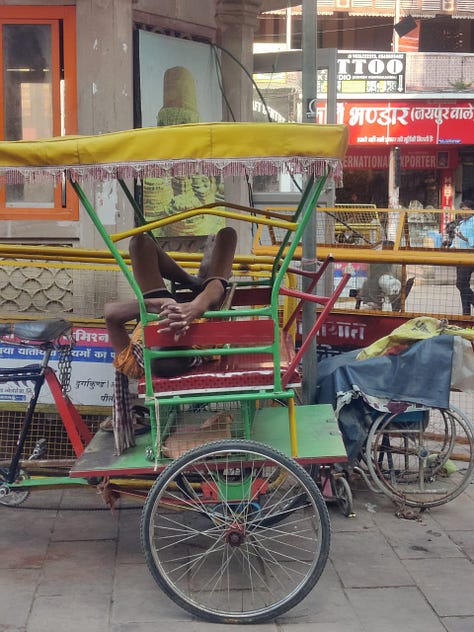
The city runs on instinct. The e-rickshaw drivers price the fare basis your look, while the pedal rickshaw drivers by the target they need to hit for the day. Riding the pedal rickshaw feels like gliding through a live city map: you get an elevated view, watching the drivers speak to each other in half-words and quick glances. They know how to slip through narrow lanes and even into overheard conversations.
When my friend jokes about having forgotten her usual breakfast, since we’re served the same aloo-puri-dahi-jalebi with the same enthusiasm every day, the driver joins in, laughing: “Didi, bahut majakiya hain aap.”
At Assi Ghat, chairs line up before dawn for Subah-e-Banaras. Chargeable grey ones for three hundred rupees and the free red ones behind for whatever guards try to extort out of you. In Banaras, all hours are business hours.
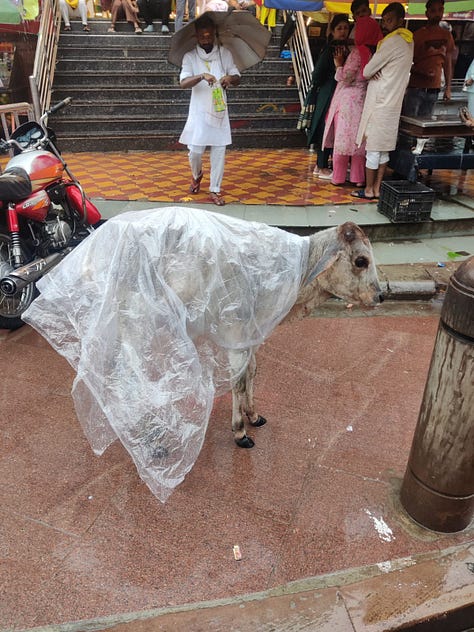
Then comes the rain. Again. Streets flood in minutes. You stop to see a calf standing perfectly still under a sheet of plastic. The lassi stall behind has some shed to offer. You casually ask about food around and suddenly it’s a full-blown panel discussion.
“Kashi chaat bhandar toh bas naam ka hai, madam”,one says.
“Deena behtar hai”, argues the other one .
“Abey, ulti patti na padhao. Madam, Kesari best hai. Main chalta hoon saath,” third one joins in.
Why have a multiplex culture when the city can still afford the culture of ‘fursat ki bakeiti’?!
Four hours later, rain has only gotten aggressive. The calf is still there, now protecting rather than being protected by that plastic sheet. Wading through knee-deep water is your only option and, you find yourself beside another traveller walking with you.
“Socha tha yahaan jaayenge, wahaan jaayenge, your friend smirks, ab lagta hai bas mar jaayenge.”
You chuckle, “Waise Banaras ki toh maut bhi famous hai.”
The stranger turns. “Tum dono humesha aisi baatein hi karte ho ki lassi pee li? Bhaang milaate hai idhar!”
A local, walking behind us, corrects him: “Arey, nahi milaate bhaang yahaan lassi mein.”
Banaras always has the last word. You are shivering and laughing; somehow four kilometres ahead look dreary yet achievable.
The water keeps rising. No transport in sight and you curse yourself for saying ‘I’d never take a dip in Ganga here.’ Well, the river made its way through the town and now you are head to toe in Ganga (amongst other things). Then, just a hundred meters away from your stay, a tempo driver offers help. Squeezed in beside him, you experience a makeshift speedboat ride you can’t complaint about. Later that night, when the city is at a standstill, the otherwise reserved hotel manager knocks on the door to share his own dinner. Warmth, more than food, fills you up.
Next day, 2 p.m. feels like 8 a.m. The city looks hungover, streets empty, shops half-shuttered, as if it’s still recovering from yesterday’s deluge. By evening, the flood has never happened: bells, hawkers, horns, laughter, all back, in surround sound, as if Banaras simply pressed ‘play’ on its usual chaos.
At the museum, guides materialise out of thin air, reciting monologues in half-Hindi, half-Bhojpuri. You catch a quarter of it maybe, but the ending is always the same: “Madam, Banarasi saree toh dekh lijiye.”
Here, every tea stall is a parliament, every joke a proverb and everyone a philosopher with an agenda.
And yes, for all its holiness, men treat the ‘city of temples’ as an open urinal. Entitlement and shamelessness apparently are part of the culture passed down, complimentary with patriarchy.
However, the architecture tells its own story; crumbling yet graceful, old but never forgotten, precious enough to make money off but not enough to maintain it. It makes you wonder if time here moves forward at all, or simply loops like the river it worships.
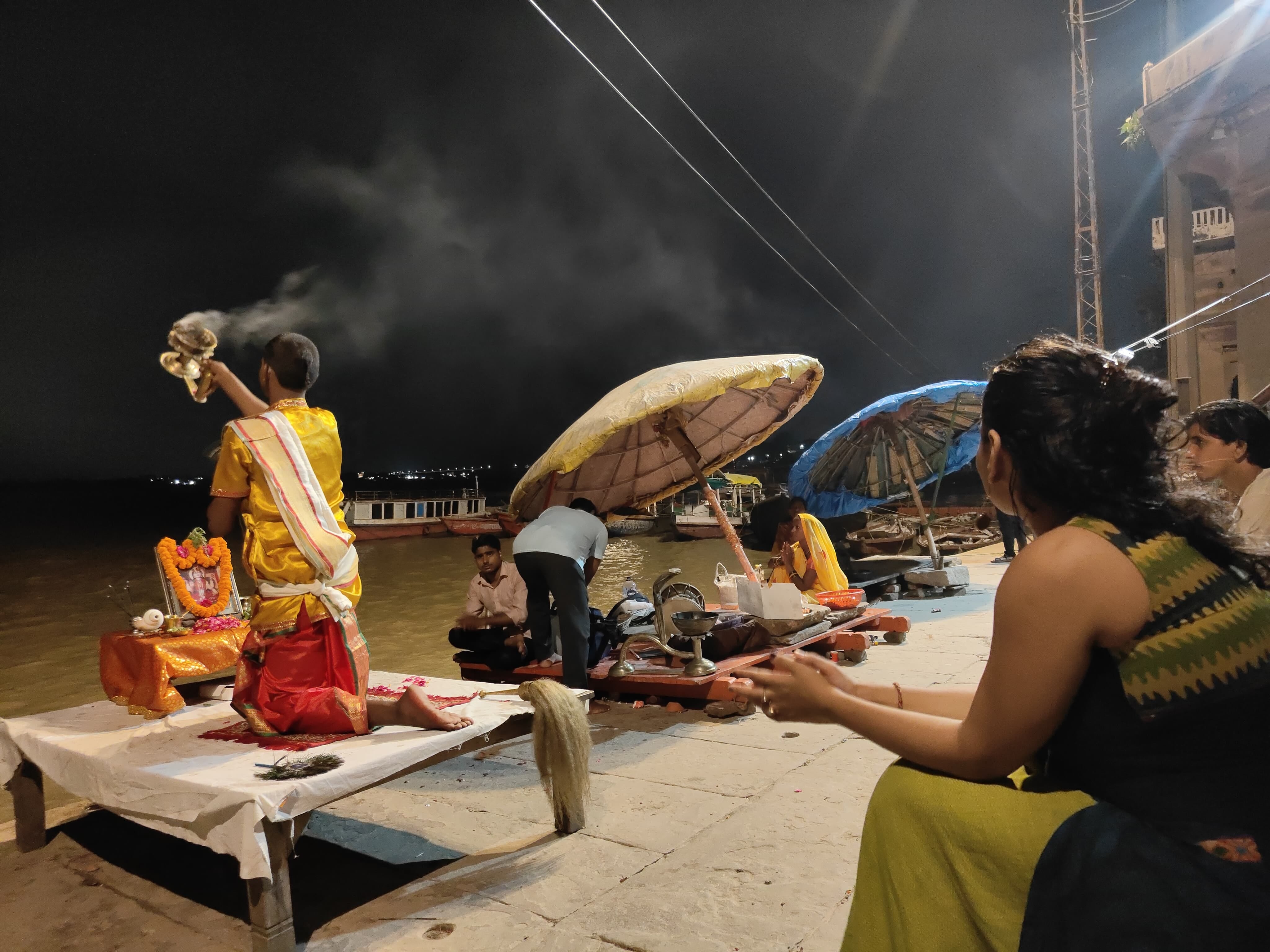
Which brings you to their daily ritual – The Ganga Aarti – the very river they pray to is the very river lined with garbage. Lamps and plastic float together in this sacred Ganga. Godliness, it seems, has little to do with cleanliness in this ‘religious’ city. Maybe we should rebrand Civic Sense as Religion.
People come here seeking meaning; you find only paradoxes too loud to ignore. No town likes a tourist who judges it, and maybe noticing too much is its own kind of blindness. Still, you’re grateful to have experienced the city that sells salvation and sarees, often in the same breath.
Somewhere, incense curls into the night, and Banaras exhales.
“Achha jaate hue woh cups le jaana aur haan, yeh rakhlo”, I said extending a tip and got back to settling my luggage. Bholaram froze and stared back in response as if he had never been tipped before.
Just an hour ago when he had crossed paths with us, Jugs and I were standing clueless on NH15 trying to navigate our way to the campus. On our left was ‘Sonu Dhaba’ surrounded by trucks and on our right, endless sand under a moonlit sky. It was Bholaram who had spotted us in distress and offered help.
A few minutes later, when we reached our destination, he started making arrangements for our sojourn. Every ten minutes, this kind gentleman knocked apologetically at our door to check on us asking, “Ma’am chai ya coffee”, ‘Cooler laga dete hai”, ‘Cleaning karva dete hai’ and so on. His hospitality had made us almost oblivion to the fact that we were there on work purpose.
Bhola, a young lean man with a large heart was agile, considerate and proactive in his demeanour. His simple appearance and overwhelming ways assured our self-occupied minds that he was a diligent helper at the institute who was also kind enough to be in our personal service. And a tip was just a way of appreciating his helpfulness.
So, what followed next makes me want to Ctrl+Z the entire situation but let’s go ahead for your amusement.
Bhola scratched his head, looked around and said softly “Erm…ma’am, I am not a waiter; we are supposed to be colleagues”.
All this while, I had accepted his kindness in a form of service that I thought I’d be paying for and not for what it was- a genuine humane quality. Is kindness really so rare that we refuse to believe how it can also come purely as a gesture?
It has been three days that I have watched Greta Gerwig’s brilliant narration of Little Women. And in these seventy-two hours, I have not yet completely recovered from Beth’s death, Jo’s inspiring and compulsive need to be true to herself, or how Meryl Steep’s Aunt March owns it when she says “I might not always be right but I am never wrong’!
I feel like Laurie will just drop in anytime and fill this space with his goofery. Three hours of watching vintage England and I am still feeling warm reminiscing Marmee’s smile! I repeat to myself her conversation with Jo where she simplifies the complexity of passionate, justifiable anger!
The friendship of Amy, Meg, Jo, Beth gives me a sense of sisterhood that I have otherwise never experienced in real life. All the March sisters are different in their dreams and passions but united with love! Jo might come across as the ideal, heroic one but all the sisters will leave a mark of them with their traits. Like Meg says, “Just Because My Dreams Are Different Than Yours, It Doesn’t Mean They’re Unimportant.”
As much as the film’s set-up and costumes transport you to the eras bygone, its context is very much contemporary; and it is very beautifully brought alive in a scene where Marmee admits to Jo about the mask that she is forced to put on every day of her life. She speaks of how she has earned this patience over the years by having to face it every day! This conversation is one of the best examples of honest writing that this film is crafted with!
Strong women with honest and strong opinions make it a story you want to watch again and again. You see it in Meg’s unapologetic, conscious desires of the domestic, familial life. It also reflects in Amy’s fearless, defiant attitude in going after what she wants. The concept of feminism is clarified to the world once again when Jo says, “Women Have Minds And Souls As Well As Just Hearts, And They’ve Got Ambition And Talent As Well As Just Beauty. And I’m Sick Of People Saying That Love Is All A Woman Is Fit For.”
Overall, Greta Gerwig’s take on Little Women is a timeless masterpiece about youth, expectation vs. reality, ambitions and a true sense for feminism!
P.S.- I ended up writing this piece because like Jo says, “Writing doesn’t confer importance, it reflects it.
It was June’17, I can tell for I remember the dry, prickly heat and the beauty of the dunes. And if signboards were to be believed, we were at some sparsely populated, low storey colony of weavers- in Bhojasar, Rajasthan. The houses- Kacha and Pucca- all carried this unique smell of yarn, atypical silence of routine and uniform taste of tea. Most of these houses were occupied by the grizzled wrinkly weavers who had lived there all their lives. Some had happily took to their family business and the rest were pushed there by circumstances. But most of these grumpy-looking old men had set their children free to choose denim over the hand-woven fabric, decaf over desi-tea…basically city-life over village-life. Gopalji said, “I don’t know if I made the right decision, but my loneliness is the cost I pay to buy them their independence!”
I gulped down the 3rd cup of tea, collected my notes and walked back to the bus station with my friend and adventure-companion, Jagruti. We took resort at a tea-stall where our local-aid, Kundanji, had first left us early in the morning. The tea-guy looked at us and whispered something to his runner. Now we had been village-hoping with backpacks for a project for a few days, so receiving those ‘Not-Fit-looks’ was not new to us. What was new was someone tiptoeing to us with curiosity and looking at us with dismay!
A bus passed by, screeched and reversed. A courageous, young lad ran to us and asked: “Are you from the city?”. Jugs nodded. He ran back and this time he came with his driver who asked, “Is it just the two of you?”
“What is the matter?” I asked.
“Don’t you chop off braids of young girls?” he asked.
“Yes, now stop bothering us or you’ll be the next” I snapped. They stepped back and the bus left.
The tea-guy looked at me with horror and dialled up a number in panic, blabbering something. The murmuring sound raised higher and higher and we were suddenly surrounded by ladies in colourful ‘odhnis’ and men in white dhotis. The sparse locality was not really so sparse, after all. Before we could register their sound and translate that to whatever little we could make of it the aunties had started sneering and repeatedly shouted ‘Baal Katni’.
At this point, the tea-guy struggled his way through the crowd and took the centre stage. He addressed the mob in a stern voice and cleared the gathering. Then he turned to us and handed us some newspapers. The titles read something like: ‘Baal Katni has entered the village’,‘Sleep outdoors and lose your hair to Baal Katni’, ‘Two urban women come to town and chop off braids of young girls’ and so on. Eh! If you pair up jeans with a loose shirt and tie your hair in a bun…what do you get? A millennial witch! Right.
By the time Kundanji made it to the spot with some help, it was too late. The situation had gone out of control. The tea-stall was lively with the natives. The runner was serving tea to everyone while Bhujia and Kachoris were doing the rounds. And, we were told the story of ‘real Baal katnis’ by the elders in the community. The same people who were scared of us and tried to scare us were showing all shades of hospitality then. The party lasted till the bus arrived. We hopped on the bus. The driver looked at us and asked: “Are you from the city?”
My only idea of a joint family comes either from my mother’s anecdotes or Suraj Barajtya films. To top that, my social life has always been more limited than a gourmet meal. So I wasn’t surprised when my decision to take up an internship with an NGO in Rajasthan came as a joke to my parents.
A week later, my friend Jagruti and I found ourselves riding in a tattered RSRTC bus trying to convince ourselves that the road further would be smoother. After landing our feet half-inch under the hot sand, we realized that what we had actually signed up for was a crash course in wilderness survival. A quick tour of the exhausting, deserted campus introduced us to our new mates- 40 sexists and 20 suppressed creatures. The former would do everything to avoid even talking to women and the latter didn’t do much of the talking. Some of them giggled to show their liking while the rest just stared. Our only instant friend was a self-inviting dog who went by the name ‘Laali’ and we figured that it was going to be a long way without any like-minded individual. Or even basic facilities.
One of my tasks there included preparing kids for a skit-marathon. Side note: Children are not my favourite species but only for the love of drama and appearing productive I jumped at the opportunity. Soon they also became our only neighbours in that otherwise-deserted hostel area. Workshop or hostel, they lingered everywhere. In the beginning, these seemingly naive cubs were quite afraid but a few days later, threat translated into a concern for them. Their hospitality alarm started buzzing and the tables turned. The notorious pack started thinking of us as their responsibility.
Next morning onwards, life became a little bothersome and then a lot smoother. They started showing up at our door each morning to give us wake-up calls, updates on the atypical hostel menu and even to help with the daily chores. Sometimes they would drop in to offer their traditional food, leak each other’s secrets, resolve their quarrels and even to give us their say on the outfit of the day.
Once during a rehearsal, little Chhattar Sinh found himself at the receiving end of my temper. Cut to a few minutes later, he was out at the door singing my favourite song and the kid had a knack. His apology led to a new ritual. Everyday post-dinner, boys would circle and entertain the workers on campus with their folk songs.
Their presence had inter-weaved with my routine so subtly that they had become a family away from family. The exchange of conversation and surprises continued to unfold as we went on a skit-performing-spree in different villages. And one fine day they rushed to the dorm, gathered around with their palms shooting, “Didi, naam likho! Didi, didi star! Sign banaona! Didi number likho!” The chaos went silent as Mahavir chacha honked loudly waving from his jeep. “Gaadi Dandkala taraf jaa rahi hai to bacho ko aaj hi ghar bhej rahe hai. Mil lo main ruka hoon paanch minute”, he said.
I turned around wishing it was some kind of a prank. The kids looked back in silence. The moment had arrived. I marked their little palms, they hugged me and none of us uttered a word, neither did we stop looking at each other until the jeep took them out of sight.
After a few days, my phone rang. A funny voice spoke in-between giggles “Didi, pata hai iss Gulaab Sinh ne kya kiya aaj?”
It was after 16 years of living away from it that I was revisiting the city of joy, palaces and tram! I had to meet this metro city and greet the remnant of bygone eras that it had so profoundly preserved, but most of all I had to trace a journey through places that I had vicariously experienced through my dad’s stories. I had to compare the original jhaal-muri to what my mum makes at home. I had to relive my ritual of struggling to complete a big, fat, sweet ‘daab’(coconut water). I had to justify the many beliefs that I had dearly held for 21 years like how ‘puchkaas’ are way more appetizing than paani-puri, how ‘singaras’ are real samosas, why it’s not a ‘roshogulla’ if it’s not a K.C.Das-make and truly revel in the satisfaction of soft sondesh melting in my mouth!
Thus, began the series of my adventures and misadventures in Calcutta! After navigating through its iconic landmarks and stunning marvels, I happened to find myself in a teeming labyrinth of Burra Bazaar’s roofed lanes. The scene playing in front of my eyes was of a street overwhelmed with hawkers, fishes, food stalls and hand-pulled rickshaws- all battling to find space and survive. And in my head, it resonated with ‘Machhua’ aka Trouble – the area that I was very specifically instructed to avoid. So, with zero network access on my phone, I headed straight to find a very credible local who could show me a way out.
I ended up on yet another trodden, cram-full footpath busy with time-worn shops, shoe-makers, fruit-sellers, tea stall and happenings more than I could register. Riveting, I looked at flavours of life unfolding in these forbidden lanes when a bright yellow taxi drove in my sight like a ray of hope!
An obese overjoyed man in his early 40s stepped out of it and gave a generous smile. I looked at the taxi, waiting for it to move forward. I looked at the man. He seemed like a rather jolly geezer. The taxi didn’t move but the chap did, right in my direction and before I knew he was running- a pitiful sight, I must say. But as soon as I realised how I had underestimated his capacity, I started running in the opposite direction. A few minutes into the chase, I realised that I had also overestimated my own stamina. Running with bag and camera gears on a dehydrating March noon was out of syllabus and not at all cinematic.
When I knew I couldn’t go any further, I did the most bizarre thing and started running towards him. He decelerated, looked back in confusion and ran away with double the speed. Just when I was wondering how long this chase would keep me running, he merged into the crowd and disappeared. I had beaten him at his own game; relief and shock, both hit me at once!
Unbelievable, isn’t’ it? That sicko double my age could run faster and better than I could. Sigh!
Making credible excuses is an art. But last week when I received an invitation to dinner-night with family friends, I couldn’t be so artistic. So I sat there, through hours of munching delicious food, artificially giggling at inarticulate recitals of WhatsApp forwards and trying to keep shut on their lopsided take on global issues.
Throughout this painful hours of socialising, only Anokhi aunty (a humanised tomato) seemed to be having a great time. Why? Because her Fossil wrist watch got her compliments not just from among the circle but also from a lady on the next table. “My son sent it from Germany for mother’s day, you know how kids are!’’, she announced trying to balance her ecstasy between modesty and pride. And that night, our waiter had a little less to do because Anokhi aunty wouldn’t spare any chance to serve our plates showing off her happy wrist.A little while after, she also happened to discover a familial connection with the restaurateur. “See? Again this happened. Mostly wherever I go someone somehoe happens to know me. See?’’, she said with a pompous grin and made her way towards the exit.
The gatekeeper started pouring us with his routine greetings except only to stop when Anokhi aunty was vigorously waving her hands in the air.
“Erm…Madam…”the waiter said as if trying to find words.
“Yes, my son sent if from Germany. Nice na? Thank you!”, chirped Anokhi aunty.
“Sure ma’am, just…er..the napkin belongs to the restaurant, ma’am”, he said.
At this point, Anokhi aunty turned into a sun-dried tomato. I could see her merriment dissolving into embarrassment in a fraction of seconds. While everyone unwittingly covered up for the damage with jocular laughter, I added, “Maybe because you kept it to yourself for a long while, it felt just like your own”
“Yes, exactly!” she uttered.
After several rounds of ‘Good-night; all of us finally dispersed but the thought lingered at the back of my mind.
Be it your coffee mug, pet or a friend- if you get comfortable around them and habituated to their presence, this congeniality is soon taken for granted. And gradually an underlying feeling of possessiveness develops. It may not be apparent but it does emerge.
Imagine meeting someone randomly on a flight and clicking with them so well that you actually sort of become fast friends… until the plane lands and then their ‘bff’ appears to pick them up. The high-fives and giggles and cheers would mean something, you thought. Maybe it did. It will be a good addition on the wall of your memory lane but you still have to give back the napkin. It matches perfect with your outfit but doesn’t belong to you and that there is the line of demarcation.
Throughout years and several experiences, we meet several such napkins. Some are too beautiful, some too comfy and some just the right fit in your fist- they feel as if tailor-made for you. It’s only human to overlook the fact that if something suits you it isn’t necessarily meant for you.We forget that we were only stopping by to admire and enjoy what is, and not possess it all.We easily escape to acknowledge this especially in terms of human relations. Next time when it’s time to let go of a friend or someone special, let them…maybe they were the napkin that didn’t belong to you.
From afar you catch a glimpse of a fascinating door that looks like the end of your search and it occurs to you ‘This is it. This is my door!’ So you ignore this fancy escalator, ditch that beautiful window and everything easy that invites you in. You head straight with excitement towards that door, jumping the hurdles and elbowing through the crowd and yes you make it there. You enter this adventure and it sure is nothing like you’ve ever journeyed on before; a new feather on your hat, a good mix of nightmares and euphoric state or just an escapade disguised as a feat! You start as a witness and before you know you become a participant- one of them, something you’re not really proud of. Eventually, on a faint rainy day, you’re done with this comfort and discomfort of new found familiarity. So, you dig your way out to the other end and what do you see far away at a distance? A beautiful door. And what do you think? ‘This is it. This is my door!’ .
Why do we street shop?
To buy that jumpsuit for some hundred bucks, is it?
Nah! It is the sheer joy of going through loads of shitty clothes to find that one piece and then fighting tooth and nail for it, defeating the vendor with your constant haggling and then walking away with your precious find like a boss.
Actually, let me break down this cheap thrill for you…
First things first, never step down rich from your cab.
The minute you enter your shopping arena…
A girl must look broke.
You are a girl on a budget; non-spendthrift and forget acting frugal; instead, pretend that your dad is a Sindhi and your mum is a Marwari. Put on that show and walk through the market keeping that childlike excitement away from your face. Look distressed if you have to but never ecstatic.
But what-so-ever, ALWAYS look like a potential- buyer giving way for the vendor to fall in the bargaining pit.
Once he starts taking interest in his to-be-customer, the battle begins.
Spot the thing of your interest, check it thoroughly with least interest. Check the ones you don’t like with visible interest. Keep your targeted dress unattended and ask its price among the other three things that you don’t intend to buy.
ACT
Whatever his quotation is, the first one has to be laughed off. Then in that flow, let your stern voice ask him for final price. He will resist. So now kill it with these three weapons
Greed- Remind him how you’ve been buying from him ever since you’ve moved to the city.
Also once in a while genuinely persuade your friend to have something for her as well from the same vendor! More the quantity, merrier the bargain!
Sympathy- Go P-l-e-a-sssssss-e with a grin and in tune! Doesn’t work? Try this-
Look disappointed in HIM. Make him feel guilty for a “regular customer” who has come a long way just so that his items would sell. Look on innocently while your silence screws his conscience!
Warning- This is the LAST resort. Tell him that it is a common thing over the market and you can get it from somebody who is reasonable. No effect?
This is where you use your ultimate weapon.
Squint at the dress for the last time. Bid it goodbye.
Now turn your heels nonchalantly, and…
WALK AWAY!
Keep walking… and wait for those magical words.9 out of ten times, the vendor in neon tee will call out for you!
The one time it doesn’t work is when he anticipates your game.
Common Sense-
The bargain hours are crucial. They don’t want to lose a customer just after they have opened for the day; while when they are closing down they want to clear the stock! So shop in desperate hours. Also, never try to bargain when it’s crowded. They won’t keep other buyers waiting to haggle with you.
Befriend the shopkeeper; smile and interact- attack his morals- he can’t overcharge somebody who has been so polite and friendly to him!
Apart from that, you can always try finding faults with the colour, fabric, fit- anything! Make him feel responsible for your trouble! Manipulate him into selling it to you.
SHOW him the MONEY. Hand it over to him. The feel of the crispy notes in his hand is bait he can’t avoid!
If You are a Tourist
Now apart from proper tourists’ place where it is obvious, avoid that tag.
Act like you KNOW the market. If you can pick up the local accent and their localised Hindi- KUDOS! Although beware against blatant pretension, that can turn the tables!
Otherwise don’t act touristy. Never “Bhaiya, hum yahin ke hai. Tourist samjha hai kya?!” That will make it obvious. Keep it natural. Don’t get easily fascinated. Act as if this is a regular thing for you.
P.S. – Bargain so that you don’t get overcharged and because it’s therapeutic (Guilty, as charged). Don’t make it your mission to screw the vendors with foul bargaining just for the heck of it.